 SABTI Riad
 Run tail -f file in one terminal and echo "something" >> file in another. The appended line shows up in the first terminal instantly — yet tail, which looks like it’s watching the file, sits at 0% CPU. So who is actually doing the work? It starts with a file descriptor that isn’t a file.
Table of contents
Open Table of contents
The file descriptor that isn’t a file

Run this:
ls -l /proc/$(pgrep tail)/fd/You get a red anon_inode:inotify entry. Try to cat it:
cat /proc/$(pgrep tail)/fd/4
…and you get a “No such device or address” error.
Isn’t everything in Linux a file? There are some exceptions, and this is one of them. inotify is a notification instance, created here by tail -f (it could be created by something else). It’s the mechanism that tells tail “bytes were appended to the file — go print them.”
Step 1 — create the station
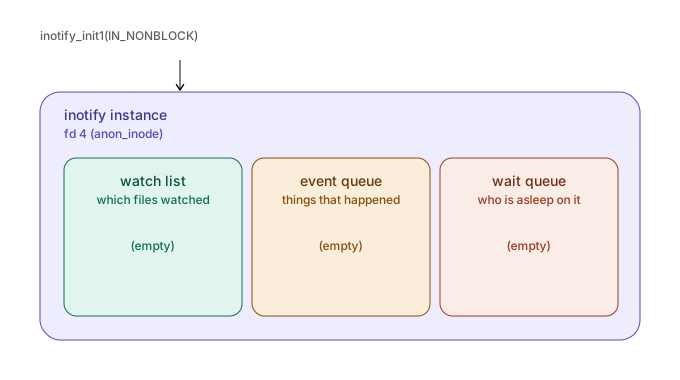
inotify is a notification station, empty when created. You’re telling the kernel “set up a station for me, I’ll use it later.” It’s built by the syscall inotify_init1(IN_NONBLOCK).
The IN_NONBLOCK argument is what separates this call from inotify_init(). It sets O_NONBLOCK on the inotify fd and governs one thing: what read(fd4) does when the event queue is empty. With it, read returns immediately with EAGAIN. Without it, read blocks until an event arrives.
Note:
read(fd4)returns event records describing what happened — not the file’s appended bytes. The actual bytes are read separately, from the file’s own descriptor (fd 3). More on that at the end.
The call returns the fd of the station (fd 4) and sets up an empty watch list and an empty event queue.
Step 2 — register the file
Now tail adds the file to the station:
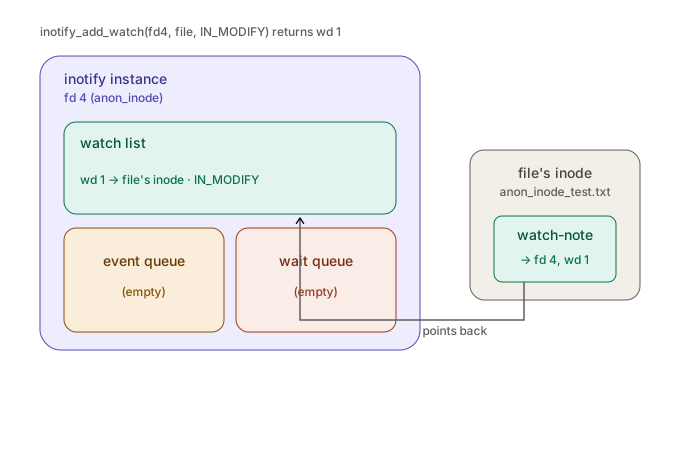
inotify_add_watch(fd4, file, IN_MODIFY | IN_DELETE_SELF | ...);The third argument is a bitwise OR of the events tail cares about — think of them as light switches (1 | 0 | 1 | 1 ...). (Real tail asked only for IN_MODIFY here, you’ll see that in the trace.)
The kernel creates a small record — the watch — and attaches it to the file’s inode:
WATCH (a kernel struct, hanging off the inode):
   ├─ which inotify instance it belongs to   (fd 4's station)
   ├─ the event mask                          (IN_MODIFY | ...)
   └─ its id number                           (wd = 1)
Think of it as a sticky note on the file’s inode: “if one of these events (MODIFY, DELETE_SELF, …) happens to me, send a message to station fd 4, tagged wd 1.”
The call returns the wd (watch descriptor), which tail stores in its own wd[] array.
Two side lessons before the next step:
pollis a syscall whose job is: “here is a list of fds, put me to sleep, and wake me when any of them has something to read — and tell me which.”- fds 0, 1, 2 are reserved for STDIN, STDOUT, STDERR.
Step 3 — wait with poll
tail fills in a pollfd form for the station (fd 4) — “wake me when this is readable”:
struct pollfd {
    int   fd;        // which fd is this form about?
    short events;    // what am I waiting for on it?   ← tail fills this in
    short revents;   // what actually happened?         ← poll fills this in
};

pollfds[0] = { fd: 4 /* station */, events: POLLIN };  // wake me if fd 4 has an event
POLLIN means “there’s something to read.” (POLLOUT is for writable, we only care about POLLIN here.)
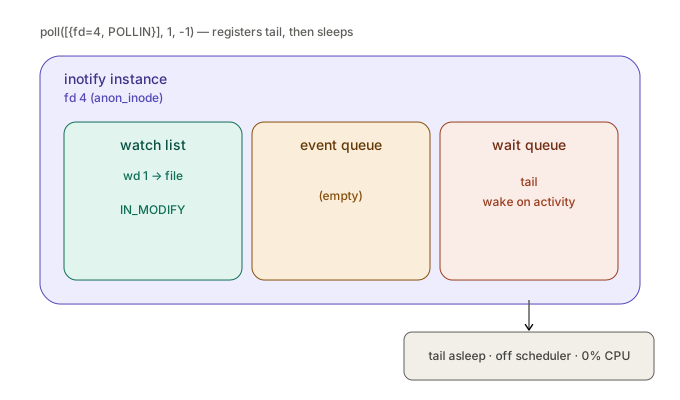
Then it calls poll(pollfds, 1, -1). The -1 means “sleep until something happens,” so this call blocks tail.
But poll does not watch fd 4 — if it did, our “0% CPU” claim would be false. So how does it work? On the way in, poll does one thing and then sleeps: for each fd in its list (here, just the inotify fd), it leaves a note on that fd’s wait queue — “these processes are waiting on me, wake them when I get activity.” Then it marks tail BLOCKED and sleeps. That registration is all poll does. It is not watching.
Step 4 — echo writes
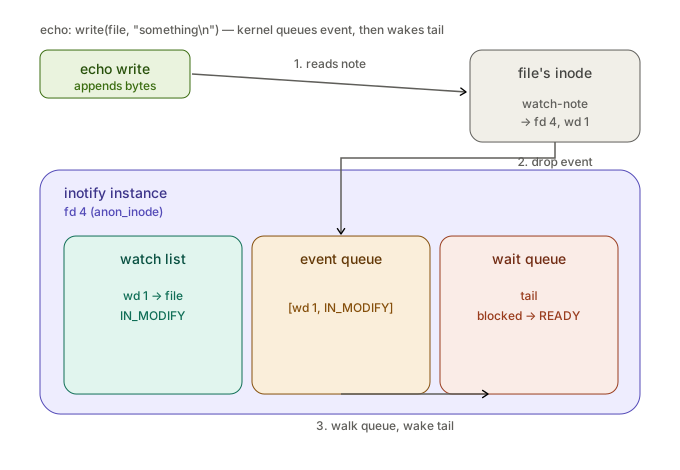
echo "something" >> file runs in the second terminal. Now echo is the one using the CPU, not tail. echo issues a write to the kernel, and inside that same write the kernel does several things: it appends the bytes, looks at the file’s inode, sees that wd 1 is watching this kind of event, queues an IN_MODIFY event into fd 4’s queue, and then — finding tail parked on the wait queue — flips it from BLOCKED to READY. write returns, echo exits.
So the writer paid the cost, then left.
Step 5 — tail wakes up
When the scheduler next picks a process to run, tail is READY, so it runs. Its poll call returns, having filled in revents so tail knows which fd woke it:
poll(pollfds, 1, -1);   // tail sleeps here... echo writes... tail wakes, poll returns

// poll has filled in revents. tail checks it:
if (pollfds[0].revents & POLLIN)   // did fd 4 (the station) become readable?
    read(fd4, ...);                // YES → read the event from the station
tail reads the event from fd 4, then reads the new bytes from the file (fd 3), prints them, calls poll again, and blocks — back to 0% CPU.
So why does a non-file have a file descriptor?
For the sake of the abstraction, so read and poll work on a notification queue with no special API. poll doesn’t know or care that the fd in the array is a fake-inode kernel object, it treats it as just another fd. The exception exists to preserve the rule: everything is a file, even when it isn’t.
Don’t trust me — check it yourself
Run tail under strace in one terminal and echo in another:
# terminal 1
strace -e trace=inotify_init1,inotify_add_watch,poll,read tail -f file

# terminal 2
echo "something" >> file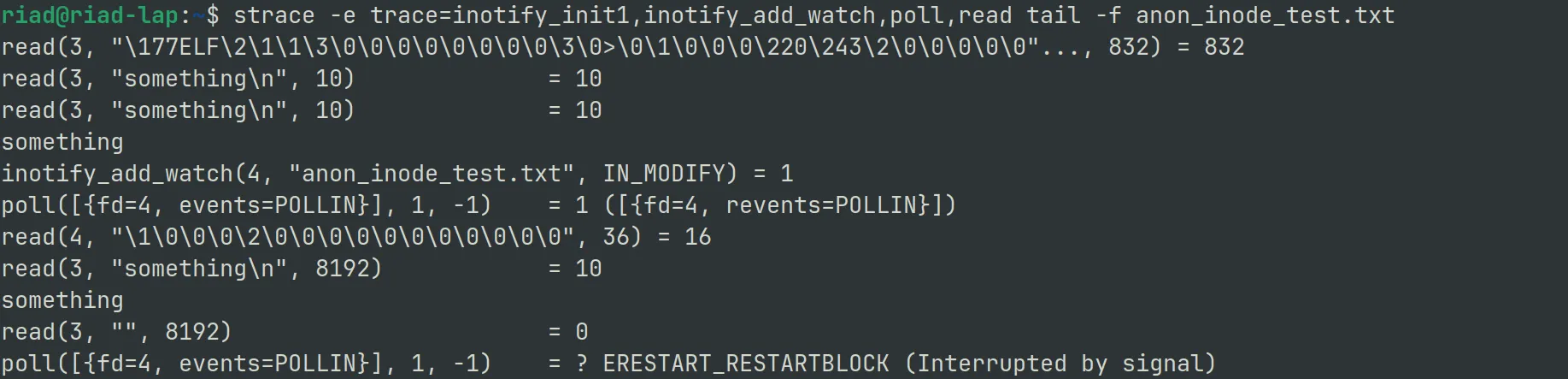
Long story short: inotify_add_watch(...) = 1 registers the watch. poll(...) hangs and that frozen line is tail blocked at 0% CPU. The moment you echo, read(4, ...) = 16 returns a 16-byte event (not your text), then read(3, ...) reads the actual "something\n" from the file. Two reads, two fds — the event on fd 4, the content on fd 3.
Thanks for reading. See you in the next one.